Choosing an Efficient Vibrating Feeder for Ultra-Heavy Duty Crushing: F5X Technology and Field Results
24 02,2026
Technical knowledge
Selecting a vibrating feeder for ultra-heavy duty applications requires more than matching capacity—it must withstand high-impact loading, keep stable feed under harsh conditions, and minimize unplanned downtime. The F5X vibrating feeder is engineered for hard and abrasive materials such as granite and iron ore, featuring up to 4.5G vibration intensity, a maximum feed size of 1500 mm, and a throughput range of 500–1600 t/h. With the FV Super Vibrator, wear-resistant steel grizzly bars, and precision CNC-machined components, it targets low failure rates and long-term reliability in demanding primary crushing lines. This article breaks down the working advantages of key components, compares performance expectations versus typical feeders in extreme conditions, and presents real-world application outcomes to help you assess fit for your site. If your goal is to keep your crushing line running with fewer stoppages and higher output—optimizing capacity from the very start—this guide offers a practical decision framework for the consideration stage.

Choosing an Efficient Vibrating Feeder for Ultra-Heavy Duty Conditions: F5X Technology, Explained
When your primary crushing line faces high-impact loading, oversize feed, and abrasive stone, the feeder becomes more than a “front-end accessory”—it becomes the part that decides whether your plant runs smoothly or bleeds downtime. In ultra-heavy duty applications (granite, basalt, iron ore, hard limestone), the right choice is the one that can absorb shock while keeping throughput stable—so your team can “reduce stoppages and produce more tons per shift”, and “optimize capacity from the source”.
Typical ultra-heavy duty constraints
- Big boulders dropping directly from wheel loader or dump hopper
- High clay/soil contamination causing clogging or irregular feed
- High abrasion wearing bars, liners, and impact zones quickly
- Unstable feed causing crusher “choking” or idle time
What buyers usually ask (and should ask)
- Can it survive impact without cracked side plates?
- Will the vibration be strong enough for hard, wet, or mixed feed?
- How often will we replace wear parts and bearings?
- Do we get stable tonnage—not just peak capacity?
The F5X Vibrating Feeder at a Glance (Data-Backed)
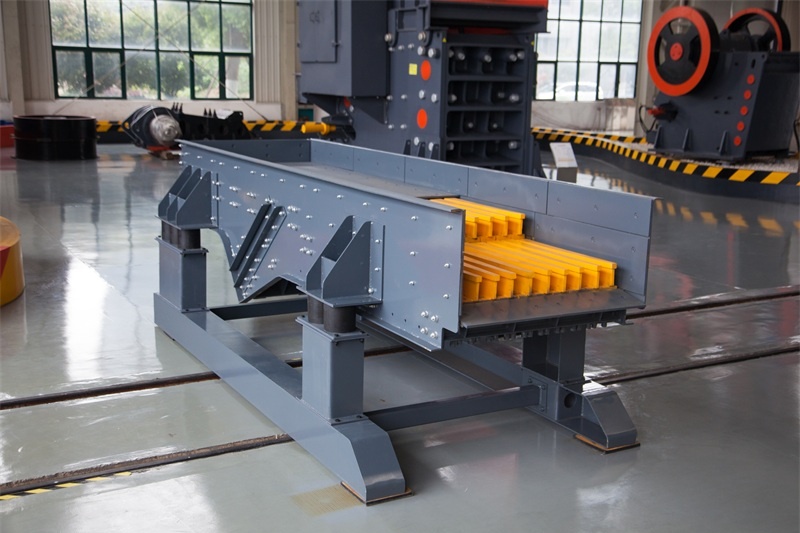
The F5X series is designed specifically for super-heavy duty primary feeding. Its core value is simple: maintain stable feed under impact and abrasion, with fewer failures—so the crusher works in its best window.
| Key Parameter |
F5X Reference Range |
Why It Matters in Ultra-Heavy Duty |
| Vibration intensity |
Up to 4.5G |
Higher acceleration helps maintain flow with hard, sticky, or mixed-size feed and reduces bridging. |
| Max feed size |
Up to 1500 mm |
Supports oversize rock without forcing extra pre-breaking, saving loader time and reducing bottlenecks. |
| Capacity |
500–1600 t/h |
Wide range enables matching different primary crushers and keeping a stable, controllable feed rate. |
| Screening option |
Wear-resistant bar grizzly / modular bars |
Pre-screens fines early to reduce crusher wear and improve overall line efficiency. |
If your current feeder looks “fine” on paper but still causes choke feeding, broken springs, cracked beams, or constant bar replacement, it’s often because the impact + abrasion + tonnage combination is beyond standard-duty design margins.
Where “Heavy Duty” Becomes “Ultra-Heavy Duty”: A Practical Selection Checklist
Many buyers only look at rated capacity and deck size. In harsh mining and quarry duty, the more decisive question is: Can the feeder keep stable output after months of impact and wear? Use the checklist below to quickly judge whether a standard feeder will struggle.
Ask yourself (or your site team) these 6 questions
- Is your maximum rock size above 1000 mm, or are boulders frequently dropped from height?
- Does your primary crusher experience either choking (too much) or starving (too little) feed?
- Are grizzly bars wearing out in under 3–6 months due to abrasive stone?
- Do you see frequent bearing temperature alarms, broken springs, or loose bolts after heavy seasons?
- Is your line target above 600 t/h with high utilization (10–20 hours/day)?
- Do you need pre-screening to remove fines and lower crusher wear?
If you answered “yes” to three or more, you’re likely in the zone where an ultra-heavy duty feeder—like the F5X—is not an upgrade “for comfort,” but a reliability decision that protects the whole crushing train.
Inside the F5X: 3 Design Choices That Reduce Failures Under Shock Load
1) FV Super Vibrator: strong excitation with controlled stability
In ultra-heavy duty feeding, it’s not only about “more force.” The feeder must deliver strong excitation while keeping vibration consistent over time. The F5X’s FV super vibrator is engineered to provide high vibration intensity (up to 4.5G) with a structure designed for endurance in continuous operation. The practical benefit is straightforward: more stable flow, less bridging, and fewer stop-start shocks that punish the crusher inlet.
2) CNC-machined critical parts: fit, alignment, and repeatability
Under heavy vibration, small misalignments become big maintenance problems. CNC machining improves dimensional consistency on critical mating surfaces and key components, which helps reduce abnormal stress concentration and loosening risks. On-site, that often translates into fewer “mystery vibrations,” easier commissioning, and more predictable maintenance cycles—especially important for operations aiming to keep the line running instead of troubleshooting every week.
3) Wear-resistant bar grizzly: protect the crusher, protect your uptime
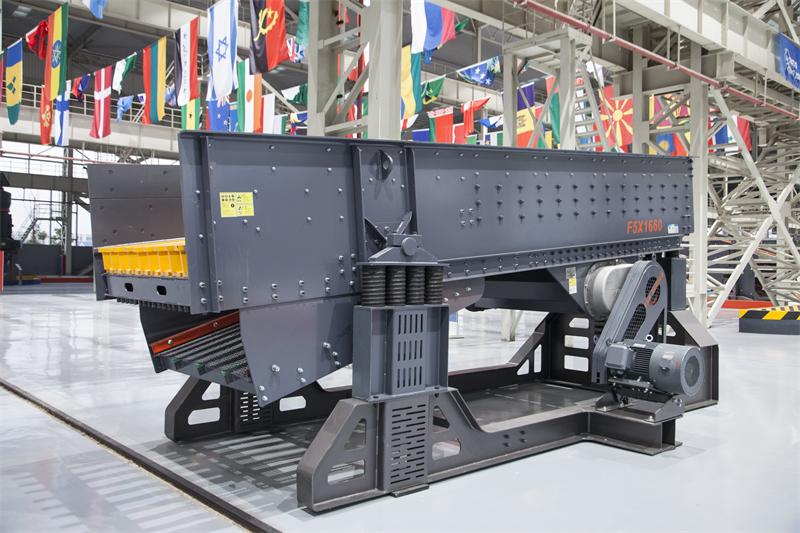
Pre-screening isn’t only about removing fines—it’s about protecting downstream equipment. With wear-resistant steel bars and a heavy-duty deck designed for impact, the F5X helps separate smaller material before it reaches the crusher, cutting unnecessary crushing load and reducing liner wear. Many sites see measurable improvements in operating rhythm: fewer blockages, smoother amp draw, and longer periods between shutdowns for cleaning or replacement.
F5X vs. Typical Heavy-Duty Feeders: What Looks Similar, But Isn’t
Two feeders may list similar “capacity” numbers, yet behave completely differently once real boulders hit the deck. Below is a practical comparison that buyers in the consideration stage often find helpful when aligning equipment specs with site reality.
| Decision Point |
Typical Heavy-Duty Feeder |
F5X Ultra-Heavy Duty Approach |
| Impact tolerance |
May require strict drop height control; higher risk of fatigue issues |
Built for harsh impact + high utilization to support stable production rhythm |
| Material flow under mixed feed |
Can bridge with wet fines + big stone; needs frequent manual intervention |
High vibration intensity supports continuous movement and more consistent feed rate |
| Wear management |
Wear parts vary by batch; replacement cycles fluctuate |
Wear-resistant bars and heavy-duty deck design aim at predictable service intervals |
| Operating stability |
Capacity peaks possible, but tonnage may swing shift to shift |
Designed for stable output—helping your crusher stay in its efficient zone |
In most plants, the real KPI isn’t the maximum momentary tonnage—it’s hours of stable running per day. That’s where an ultra-heavy duty feeder can quietly become the most profitable “upgrade” on the site.
.jpg)
Application Scenarios: What “Better Feeding” Looks Like on Real Projects
The best way to evaluate a feeder is to picture it in your exact front-end conditions: hopper design, loader behavior, drop height, moisture, fines ratio, and daily run time. Below are two typical scenarios where the F5X is commonly considered.
Scenario A: Large quarry crushing granite for aggregates
A quarry processing hard granite often deals with high abrasion and large feed variation. After switching to an ultra-heavy duty feeding setup, operators typically report:
- More stable crusher loading, with fewer “surge” events
- Reduced manual clearing around the grizzly zone
- Longer wear part life in the crusher due to earlier fines removal
In many hard-rock sites, improved stability can lift effective hourly output by 5–12% versus a feeder that frequently starves or chokes the crusher (actual results vary by material and layout).
Scenario B: Metal ore project with oversize boulders and long daily runtime
In iron ore or similar metal ore operations, the key pressure is continuous utilization. A feeder stop can create a chain reaction: crusher idle time, conveyor stoppage, and downstream stockpile imbalance.
- Supports large feed size (up to 1500 mm) to reduce pre-break handling
- High vibration intensity aids flow control even with mixed gradation
- Improved predictability for maintenance planning and parts stocking
For sites running 12–20 hours/day, the value often shows up as fewer unplanned stoppages—helping the team “reduce downtime and push more tons out” without forcing the crusher beyond its comfort zone.
“After commissioning the feeder, the crusher feed became noticeably steadier. The biggest win is fewer interruptions during peak hours—our line spends more time producing and less time waiting.”
— Site operations manager (hard rock crushing line, North Africa)
Spare Parts & Service: The Quiet Factor That Lowers Operating Risk
Ultra-heavy duty equipment is bought for reliability—but reliability is also a system: parts availability, wear strategy, and commissioning discipline. When evaluating the F5X for your line, it’s worth confirming the practical support items that keep your operation protected.
Parts strategy that makes sense on-site
- Recommended wear parts list based on stone abrasiveness
- Stocking guidance for bars, fasteners, and critical consumables
- Planned inspection points to catch issues early
Service that protects commissioning quality
- Installation checks: alignment, anchoring, and vibration isolation
- Start-up tuning: feed control targets and grizzly efficiency
- Maintenance training for local crews
A practical way to think about it: when the feeder is right, your whole line becomes easier to operate. When the feeder is wrong, everyone ends up “fighting the front end” every shift.
Is the F5X the Right Fit for Your Crushing Line? Try This 60-Second Match Test
Before you request a formal selection, it helps to map your conditions to the feeder’s design intent. If your site includes hard rock, high drop impact, oversize feed, and a target of 500–1600 t/h, the F5X is often a strong candidate. If your material is soft, low-abrasion, and the line runs intermittently, a lighter-duty solution may be more cost-efficient.
Interactive questions (answer with your site data)
- What is your max feed size (mm) and typical drop height (m) into the hopper?
- What is the target throughput (t/h) and daily runtime (hours/day)?
- Is your material granite/basalt/iron ore or another high-abrasion stone?
- Do you need pre-screening to remove fines before the primary crusher?
CTA: Get an F5X Selection Recommendation for Your Ultra-Heavy Duty Feed
Share your material type, max feed size, and target tonnage—and get a practical feeder configuration suggestion to help your crushing line stop less and produce more, optimizing capacity from the source.





.jpg?x-oss-process=image/resize,m_fill,h_600,w_600/format,webp)
.jpg?x-oss-process=image/resize,m_fill,h_600,w_600/format,webp)
.jpg?x-oss-process=image/resize,m_fill,h_600,w_600/format,webp)


.jpg?x-oss-process=image/resize,m_fill,h_600,w_600/format,webp)




 Facebook