In today’s mining and aggregate operations, companies often face a common challenge: processing multiple rock types—like limestone, granite, basalt, and even metal ores—on the same production line. Traditionally, this meant investing in separate equipment for each material type, increasing capital costs, maintenance complexity, and labor needs. But what if you could do it all with one machine?
According to industry reports, over 60% of mid-sized quarries now process at least three different rock types annually. This shift is driven by market demand—building materials, construction aggregates, and specialty minerals are increasingly sourced from mixed deposits. The key question isn’t just “can we handle this?” but “how efficiently?”
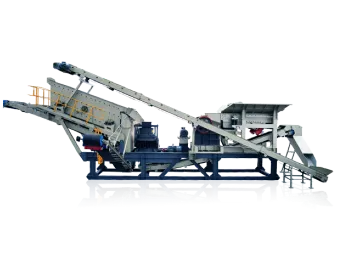
Enter the HPT Multi-Cylinder Hydraulic Cone Crusher, engineered not only for high throughput but for adaptability across hardness ranges—from soft limestone (Mohs scale ~3) to hard basalt (~6.5). With optimized crushing chamber design and intelligent control systems, it delivers consistent performance regardless of feed composition.
Compared to older single-material cone crushers, HPT models show up to 30% higher throughput when switching between materials like dolomite, quartzite, and iron ore—all without recalibration or downtime. In a case study from a Chinese stone factory, after integrating an HPT crusher into their dual-line operation (processing both limestone and dolomite), they reduced energy consumption per ton by 18% and cut operator hours by 25%.
Key Metrics You Can Trust:
Unlike traditional impact or jaw crushers that rely heavily on fixed settings, HPT uses a patented layer-pressure crushing principle—where stones crush each other under controlled pressure inside the chamber. This method naturally adapts to varying particle sizes and hardnesses, reducing wear and improving product uniformity.
Combined with a real-time PLC monitoring system, the crusher automatically adjusts parameters such as eccentric speed, hydraulic pressure, and motor load based on live feedback from sensors. No manual tuning required—just plug-and-play versatility.
For plant managers, this means fewer machines, lower inventory, and simplified training. For business owners, it’s about agility: being able to pivot quickly when new contracts come in—whether it’s building sand for concrete or raw material for metallurgy.
One client in Saudi Arabia recently shared: “We used to run two separate lines—one for limestone, one for basalt. Now with one HPT, we’re saving 30% on operating costs and have more capacity to take on new projects.”
You don’t need to choose between efficiency and flexibility anymore.
Let us help you assess your current setup—and show how a single HPT hydraulic cone crusher can solve multiple material challenges.
Get Your Free Multi-Material Crusher AssessmentDo you also face the challenge of multi-rock-type processing on one line? Let us know below—we’ll reply personally with tailored insights.



.jpg?x-oss-process=image/resize,m_fill,h_600,w_600/format,webp)

.jpg?x-oss-process=image/resize,m_fill,h_600,w_600/format,webp)

.jpg?x-oss-process=image/resize,m_fill,h_600,w_600/format,webp)

.jpg?x-oss-process=image/resize,m_fill,h_600,w_600/format,webp)

 <#else>






 Facebook